
From one person’s head to a system your team runs
We find what still rests on one person, build the system that carries it, and prove the handover.
Gökhan Üç · Business Architect · Founder, Freedom Architects · London · Istanbul
Fifteen years in corporate and structured finance at BNP Paribas Group

Built around one person, ready to grow beyond one
That is how most owner-led businesses are built, and it works. Then growth, time off or a sale starts to ask more of it.
Key clients still call the founder first.
Prices and exceptions still end on one desk.
How the work is done lives in one head.
Time off still comes with a phone.
Three places it shows
For the owner: weeks that never quite become a holiday.
For the business: decisions wait on one desk, and good people stop waiting.
For a sale: share of UK deals in 2025 with an earn-out, where part of the price waits on how the business runs afterwards.
CMS European M&A Study 2026
Built for the owner-led business
The point where what makes the business work has to move from one person’s head into the company itself.
You stay. You keep control. The load moves to your team.
To a management team, the next generation or an employee ownership trust.
Getting ready 12 to 24 months ahead, so your team carries the day to day before buyers look.
Four steps, ending in a four-week test
The system is decision rights, roles, processes, knowledge and rhythm, written down and used every week.
Where does the business still lean on one person?
20 indicators across five areas: customers, decisions, knowledge, team and systems.
Who takes the load, and under which rules?
Roles, decisions, flow, rhythm and numbers, in writing.
In what order does it move?
Decisions handed to named people, and the managers who take them on coached.
Did it really move?
Four weeks of evidence.
A task counts as handed over only when a named person has run it for four weeks without the founder stepping in: written flows, decisions at the level the decision map sets, results in the monthly management meeting.
Five questions, answered in writing
Owners
Who owns what?
Organisation chart and role cards
Decisions
Who decides what?
A decision map with written limits
Flow
How does work move?
One accountable person per step
Rhythm
When do we decide?
A weekly meeting the team runs
Numbers
How do we know?
A monthly scoreboard, every number owned
“The team runs the day to day. The owner keeps the decisions that matter most.”
Where to start
Selling in 12 to 24 months? The same path, timed to finish before due diligence starts. Your adviser runs the sale; I get the business ready for it.
Fixed fees and a finish date, agreed in writing before the work starts. You decide what moves.
Every colour has its evidence
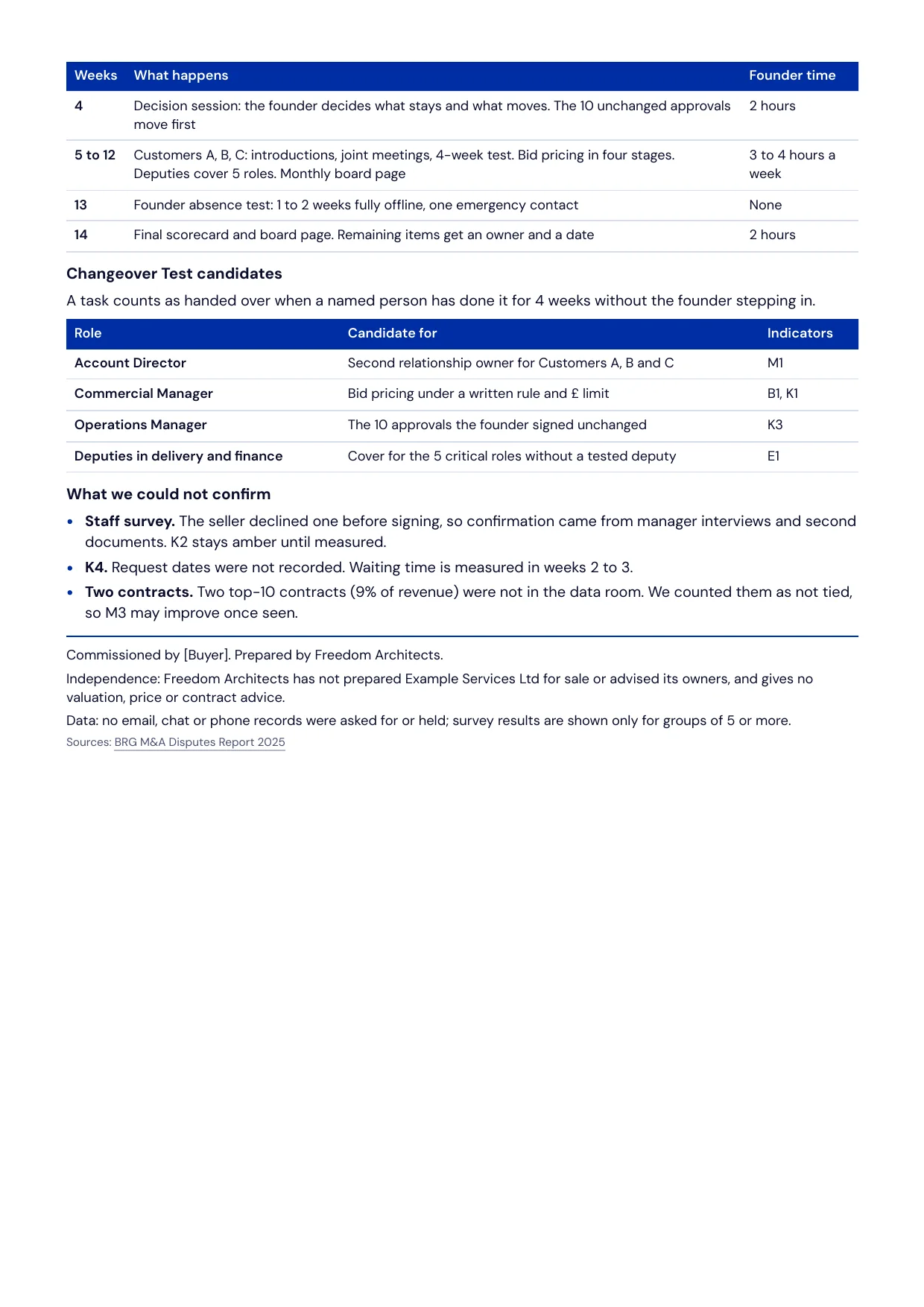
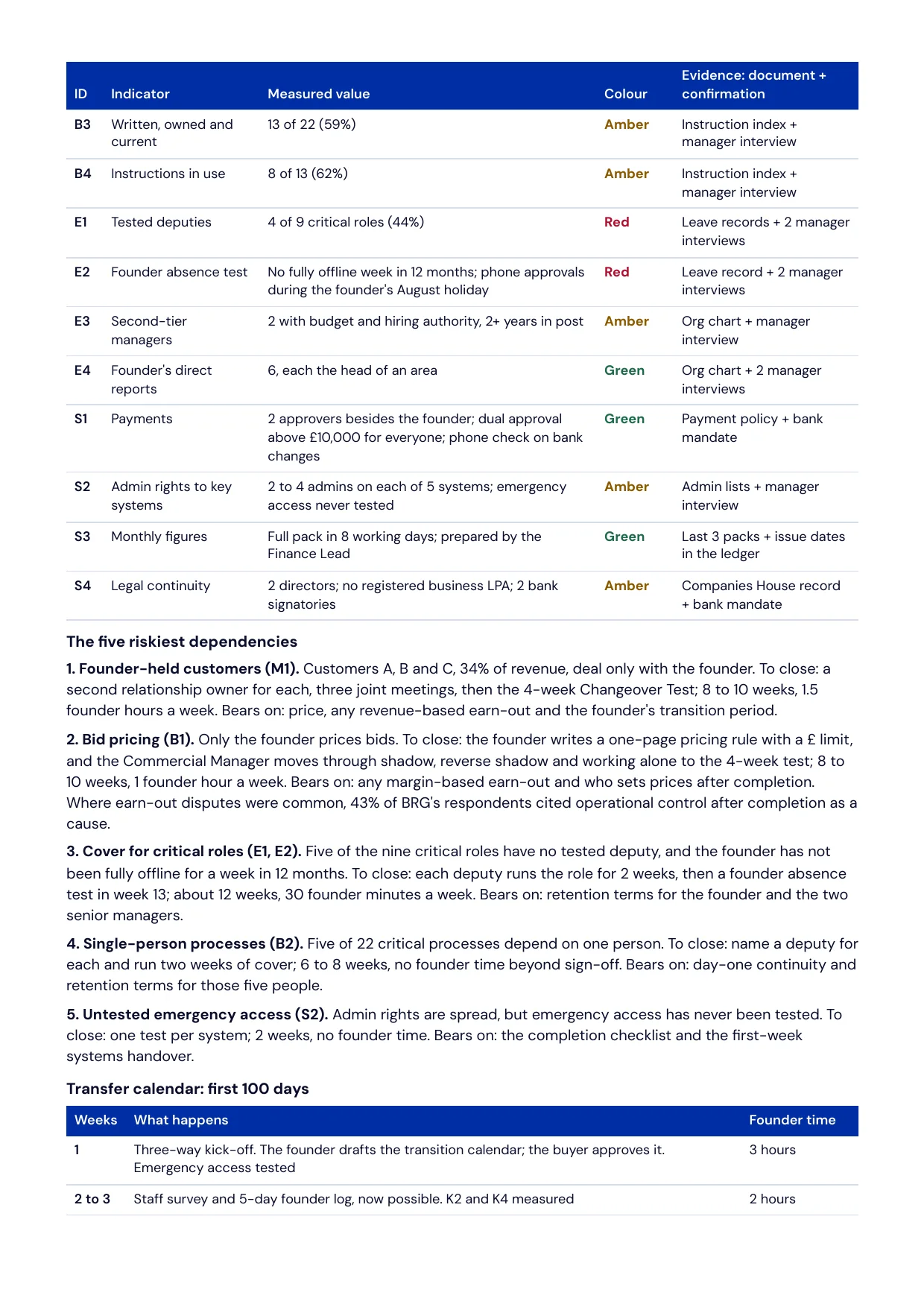
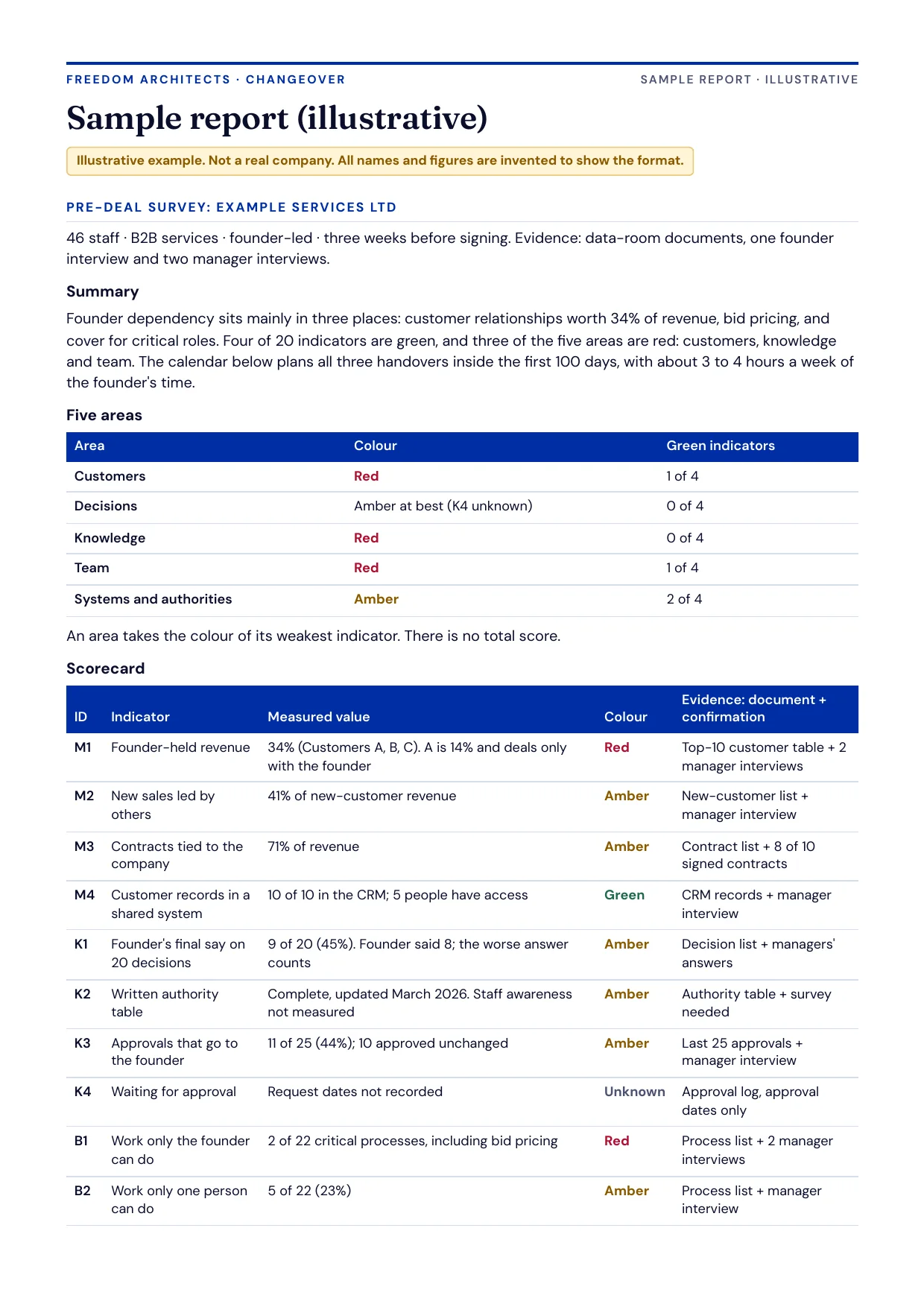
Illustrative example. Example Services Ltd is not a real company; names and figures are invented to show the format. 46 staff, B2B services, founder-led.
The scorecard. 20 indicators, each with a measured value and the evidence behind its colour.
The five riskiest dependencies. How to close each one, and what it bears on.
A transfer calendar. Who takes over what, and the founder’s time each step needs.
Founders get the same scorecard in the Blueprint; buyers get it in the Pre-deal Survey.
An area counts as covered only with a document and confirmation from someone other than the founder.

Fifteen years without a holiday, then four weeks away
“Thanks to what you’ve built, we now work more efficiently and effectively than I could have imagined. I have even started taking holidays where I go days without looking at my phone.”
Mike, founder · a property business, turnover around £40M a year
to approve payments, on his first uninterrupted family holiday in fifteen years
sales, as the business grew from three countries to seven
time to close a sale
Approximate figures. Mike is happy to take a reference call. Read the case study
Mike’s property business, scored twice
A real client, not an illustration. Turnover around £40M a year, now in seven countries. The same 20 indicators, at the start of our work and today. Approximate figures. Reference call available
Alongside your advisers
One side per deal
Never the buyer and the seller of the same business.
No price or deal advice
That stays with your corporate finance adviser and lawyer.
One client
The client is whoever commissions the work. Every report says who that is.
Interim managers and new hires
Where a second line is missing, I work alongside the interim manager or the new hire.

I take on a handful of firms a year
Fifteen years in corporate and structured finance at BNP Paribas Group, assessing businesses the way lenders and investors do. One pattern repeats: lenders and buyers discount how much of the company lives in the founder’s head.
20 minutes, no pitch. Founders usually start with the Blueprint.